


Blog
KNX Motion-Triggered Lighting: Lights That Turn On When You Enter a Room

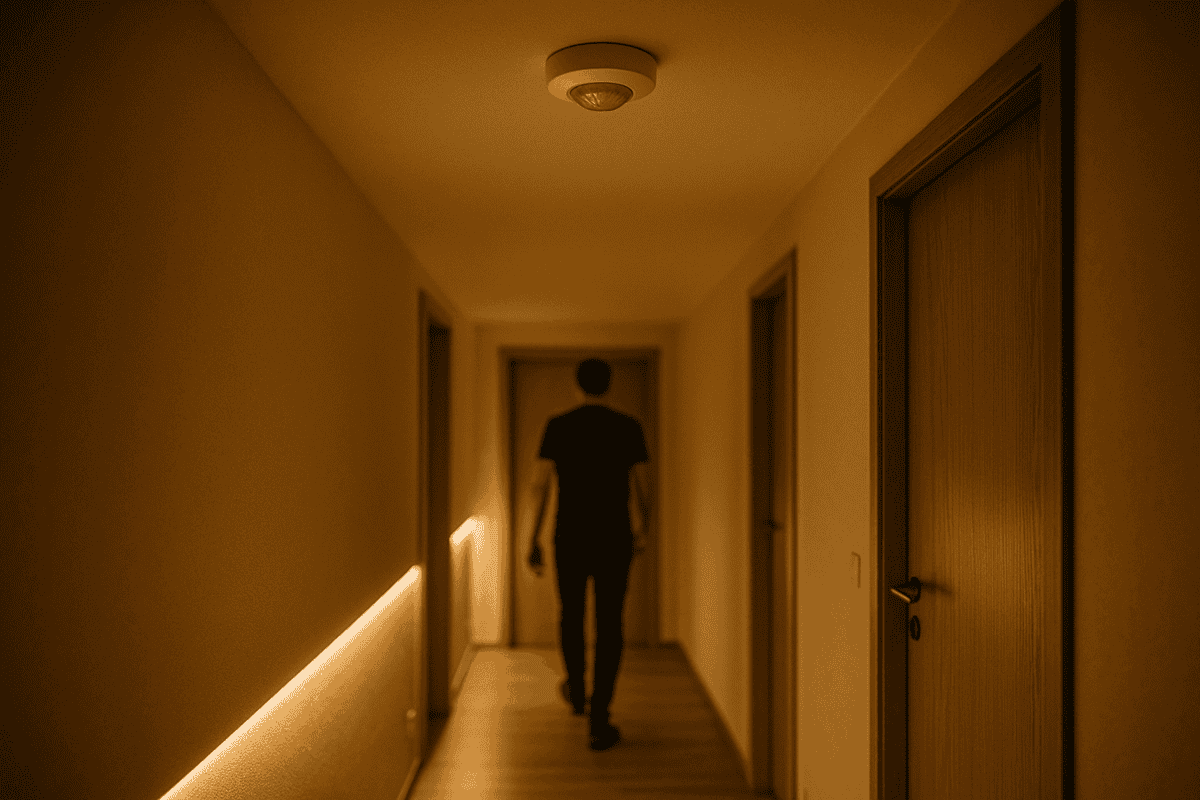
KNX motion-triggered lighting works much like a conventional light switch — except it activates itself. You walk into a room, the light comes on. You leave, it turns off. No fumbling for a switch in the dark, no coming home to find every light you forgot to turn off still blazing.
What KNX motion-triggered lighting actually is
The core component is the KNX motion detector — the device that “sees” movement in a room and sends a command over the KNX bus to an actuator (the relay that switches the lighting circuit). Think of it as an invisible attendant watching the room and acting on your behalf.
The system uses the KNX protocol (ISO 14543) as its communication layer. When the detector picks up movement, it sends a telegram over the dedicated KNX bus cable. The actuator receives the command and switches the lighting circuit on. No movement for a set period, and the actuator switches it back off.
The key difference from a standard PIR detector with a built-in relay is this: a KNX detector does not directly switch the light. It sends information. That separation between “brain” (the detector) and “muscle” (the actuator) is what makes complex scenarios possible — a detector in the hallway can trigger the kitchen lights too, or activate exterior lighting when movement is detected on the ground floor at night.
What changes compared to a conventional setup
Most homeowners have experienced walking into a dark room and groping for a switch, or driving away from home wondering whether they left the lights on. KNX motion-triggered lighting solves both.
Measurable energy savings: In a 70 m² apartment fitted with eight KNX detectors, it is realistic to see a 35–40% reduction in lighting energy consumption. Lights switch off automatically after a configurable period of inactivity — typically two to ten minutes — rather than staying on for hours.
Comfort without compromise: You step into the bathroom at night and the light comes on at 30% brightness — enough to see, not enough to wake you fully. In the living room, the detector activates a “reading” scene with warm light at 70%. In the kitchen, it switches on both the under-cabinet LEDs and the main ceiling fixture.
Flexible programming: A conventional PIR detector offers only on/off. A KNX detector can activate different scenes depending on the time of day: full brightness in the morning, 50% in the evening, 20% warm light at night. It can also introduce a short delay — orientation lighting first, then the main ceiling fixture three seconds later.
Integration with other building functions: When the system detects that nobody has moved for 30 minutes, it can trigger a “Leaving” scene: all lights off, blinds down, alarm armed. A standard PIR relay cannot do any of this. For a full picture of what KNX automation covers, see our KNX integration services overview.
What stays the same is the electrical backbone: the 230 V wiring to each lighting point is unchanged. KNX actuators are installed in the switch back-boxes or a small local enclosure — there is no need to run extra heavy cable back to the main distribution board.
Who benefits most from KNX motion lighting
Homeowners who want to forget about switches
- Families with young children: no searching for a switch when your hands are full
- Older residents: lights come on as you enter — no reaching around in the dark
- Homes with multiple corridors or staircases: lighting activates progressively along your route
- Anyone who forgets: lights turn themselves off, every time
Because KNX runs on a dedicated bus, the detectors work entirely locally. There is no dependency on Wi-Fi, a cloud server or a home router. If the internet goes down, your lighting continues to behave exactly as programmed. This is one of the reasons KNX is the preferred choice for luxury villas and high-end residential projects.
Architects designing contemporary spaces
Motion-triggered lighting removes the need for wall switches in certain areas — corridors, utility rooms, WCs, stairwells. Walls stay clean. Detectors fit flush into the ceiling or sit discreetly in a corner, barely visible.
In commercial projects — hotels, offices, retail — KNX detectors cut energy costs significantly and eliminate the perennial complaint that staff leave lights on. See how this applies in hotel and hospitality environments and office and commercial buildings.
Electrical contractors looking for straightforward installation
A KNX motion detector installs much like a conventional one — two bus wires from the detector to the actuator. Mounting requires no specialist KNX training. The programming is handled separately in ETS6, but the physical installation is familiar territory for any competent electrician.
The long-term advantage for contractors and their clients: if the logic needs to change — different lights, revised timing, a new scene — nothing is rewired. The configuration is updated in software only.
How to implement KNX motion-triggered lighting
Step 1 — Space analysis and detector placement. In a three-bedroom apartment, six to eight detectors typically cover all the key zones: living room, kitchen, bedroom, bathroom, hallway and entrance. Materials cost for detectors and actuators at this scale generally falls in the range of €1,200–€1,800, depending on brands and specification.
Step 2 — Installation and cabling. Allow one to two days for an apartment and three to four days for a larger house. The electrician installs the actuators in the switch back-boxes and runs KNX bus cable between detectors and actuators.
Step 3 — ETS6 programming. This is where the intelligence is defined: which lights activate, at what intensity level, after how long they switch off, and how behaviour changes by time of day or scene. Our KNX design and ETS programming service covers this stage in full.
Realistic timeline: From placing an equipment order to a fully operational system, expect two to three weeks — roughly one week for delivery and one to two weeks for installation and commissioning.
It is worth noting that KNX has been an international standard (ISO 14543) for over 30 years, with more than 500 manufacturers worldwide. You are not locked into a single supplier: a Steinel detector, an MDT actuator and a Jung panel can all coexist in the same installation and work together seamlessly.
Is KNX significantly more expensive than conventional PIR detectors?
A standard PIR detector costs roughly €30–50. A KNX detector sits in the €120–180 range. The difference is real, but the payback period is short: a 35–40% reduction in lighting energy in a typical apartment translates to savings of around €15–25 per month. Add in the convenience of never hunting for a switch, and the value case is straightforward within the first year.
What happens during a power cut or internet outage?
KNX detectors communicate via the bus — no internet connection is involved. When power is restored after an outage, the system resumes its programmed behaviour automatically, with no manual reset needed. This stands in contrast to Wi-Fi-based smart lighting, which commonly loses its configuration or fails to reconnect after even a brief power interruption.
Am I locked into one installer or supplier for ongoing maintenance?
No. Because KNX is an open international standard, any engineer with ETS6 software can modify the programming. Devices from different manufacturers work together in the same system. If you ever need to adjust scenes, add detectors or change timing, it is a software task — not a rewiring job. Our KNX remote support and maintenance service makes that even more convenient, with many changes handled without a site visit.
Ready to get started?
If you would like to understand exactly what KNX motion-triggered lighting would involve for your specific property — costs, detector layout and programming scope — request a quote and we will come back to you with a clear, no-obligation proposal tailored to your project.





