


Blog
KNX Letour Automation: A Smart Home Without Technical Compromise

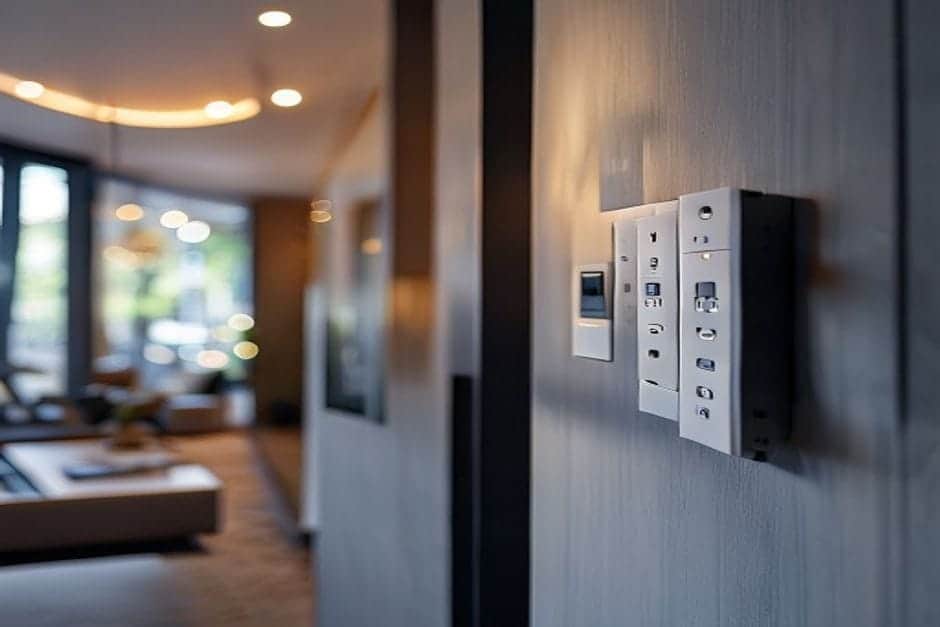
What does a KNX installation that keeps running without issue for years actually look like? This case study answers that question. Eighteen months ago we completed a full home-automation project in a 180 m² villa using Letour KNX switches with integrated relays — a technology that moves the actuator off the distribution board and into the wall box, right behind the switch plate.
The homeowner’s brief was clear: complete automation of lighting, blinds and climate — but without turning the distribution board into an impenetrable wall of DIN-rail actuators. KNX Letour made that possible.
The Challenge: Full Automation, Tidy Installation
KNX is the international standard (ISO 14543) used in over 190 countries, and for good reason — it is open, robust and built for decades of service. But a conventional KNX fit-out for 45 circuits in this villa would have meant:
- 15 DIN-rail actuators occupying significant space in the distribution board
- Considerable extra cabling running back from every circuit to the board
- Complex fault-finding — any issue sent the engineer to the board first
- A larger enclosure to accommodate all the hardware
Anyone who has stood in front of a board packed with actuators and struggled to identify which one controls which circuit will understand exactly what we were trying to avoid.
The KNX Letour Approach
We chose Letour switches with integrated relays. The actuator — the device that physically switches the circuit — lives inside the wall box, directly behind the switch. Intelligence is distributed throughout the building rather than concentrated in one enclosure.
The installed configuration for the villa:
- 22 Letour KNX switches with integrated relay for lighting control
- 8 Letour blind actuators mounted locally at each motor
- 1 central KNX thermostat with temperature sensors in every room
- Letour IP gateway for smartphone and tablet control
The result for the distribution board: only protective devices and the main contactor — nothing else. All KNX logic sits distributed around the home, exactly where it is needed.
Fault-finding changed completely. Previously, a lighting fault meant a trip to the board. Now, if the living-room lights do not respond, the engineer goes directly to the living-room wall box. The problem is localised before a single tool is picked up.
For a deeper look at how we approach KNX lighting control design, including actuator placement strategy, see our dedicated service page.
Results After 18 Months
- 23% reduction in electricity consumption through automated lighting and climate scheduling
- Zero service call-outs in 18 months of operation
- Average fault diagnosis time: 5 minutes, compared with 30+ minutes in a conventional board-based setup
- Full household adoption — the system is part of daily routine, not a novelty
That last point matters most. Lights come on automatically when someone enters the house. Blinds close at sunset. The heating and cooling schedule runs itself. As the homeowner put it: “The first month I played with the app. Now I never think about it — the house just works.”
That is the mark of a well-designed KNX villa installation: the technology becomes invisible because it is doing exactly what was asked of it.
Four Lessons From This Project
1. Integrated relays simplify everything downstream
Installation is cleaner, fault-finding is faster, and routine maintenance does not require a specialist for every minor issue. A faulty switch is replaced in isolation — no other circuits are affected.
2. The upfront cost difference is real but recoverable
Letour integrated-relay devices cost roughly 15–20% more than conventional DIN-rail actuators per circuit. However, savings on cabling length, board-assembly labour and long-term maintenance typically offset that difference within the first year of operation. A 23% energy saving on a 180 m² home translates to approximately €350–450 per year — the system pays for itself from energy alone within seven to eight years.
3. Good automation is invisible
When a system is programmed correctly, occupants stop thinking about it. The home anticipates needs rather than demanding attention. This is the practical goal of any KNX ETS design and programming engagement — not impressive demos, but reliable, unobtrusive daily operation.
4. Component quality determines long-term reliability
Zero faults over 18 months is not luck. It is the outcome of specifying tested components and commissioning them properly. Cutting corners on hardware or programming is where most smart-home disappointments begin.
Frequently Asked Questions
What happens if a Letour integrated-relay switch fails?
Only the affected switch needs replacing. Because each device is independent, a fault stays contained — no other circuits are disrupted. Replacement parts are typically available with 24–48 hour delivery across Europe. In this project, no replacements were needed in 18 months.
Can new functions be added after installation?
Yes. The KNX bus remains in place and additional switches, sensors or actuators can be added at any time. In this project, an automated garden irrigation system was integrated six months after handover — it connected to the existing KNX bus without any changes to the original wiring.
Does Letour work with existing wiring?
In the majority of cases — around 80% of retrofit projects — Letour devices can be installed on existing wiring without full recabling. This makes them particularly well suited to renovation projects where rewiring is impractical or costly. Our KNX commissioning team assesses wiring suitability as part of every site survey.
Is KNX Letour suitable for apartments as well as houses?
Absolutely. The distributed, compact format of integrated-relay devices is arguably even more valuable in apartments where distribution board space is limited. See our KNX for apartments page for relevant examples and considerations.
Thinking About a Similar Project?
Every home is different, and the right configuration depends on your floor plan, existing wiring, and what you actually want the system to do. If you would like an honest assessment of what KNX Letour automation could look like for your property — with realistic costs and timelines — get in touch for a no-obligation consultation. We work with homeowners, architects and electrical contractors across Europe.





