


Blog
KNX Alexa Integration: Voice Control Your Home Without Changing the Installation

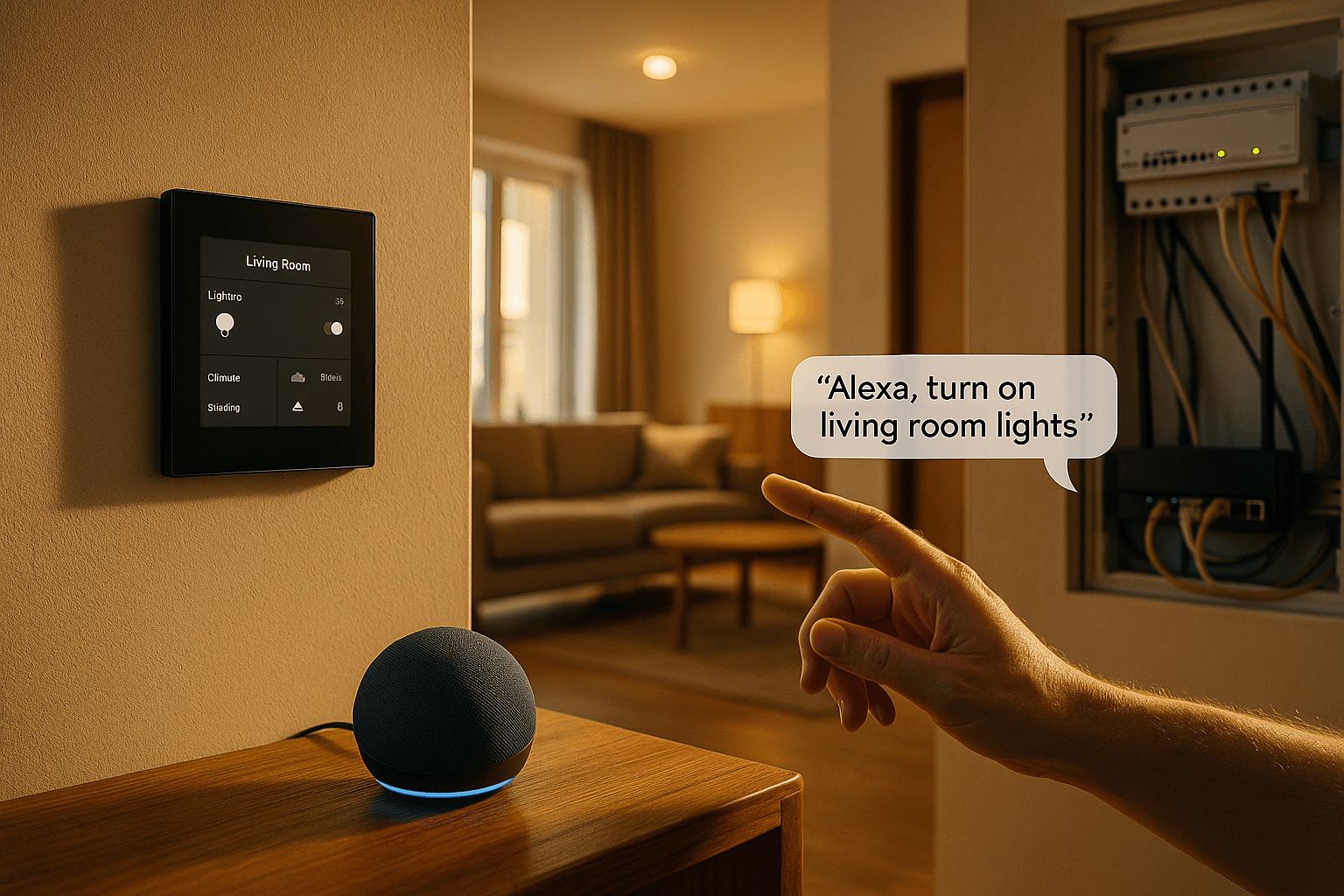
Let’s be clear about what KNX Alexa integration actually means: it lets you add Amazon Alexa voice control to an existing KNX installation without touching the wiring or reprogramming a single group address. If you have been wondering how to control KNX lights, blinds or heating by voice, the answer is simpler than most people expect.
Many homeowners with solid KNX systems feel a quiet frustration when they visit a friend whose cheap Wi-Fi smart home responds to voice commands. The good news is that you do not have to choose — you can have the reliability of KNX and the convenience of Alexa at the same time.
How KNX and Alexa actually connect
KNX (ISO 14543) and Amazon Alexa speak completely different languages. The bridge between them is a KNX IP gateway — a small device installed in the distribution board that translates Alexa commands into KNX telegrams and sends them onto the bus.
In practice: you say “Alexa, turn off the living room lights”, the gateway picks up the command from the Alexa cloud and fires the correct KNX telegram to the relevant actuator — the device that physically switches the circuit. The whole sequence takes under a second.
The key point is that your KNX installation is not modified. The gateway simply listens alongside everything else already on the bus. Your ETS programming and all existing group addresses stay exactly as they were.
What changes — and what stays the same
Before integration: you press a physical switch or open the KNX app on your phone. Setting up a complex scene — dimmed lights, blinds at 60%, temperature at 21 °C — means three or four separate actions.
After integration: you say “Alexa, activate Movie mode” and everything adjusts simultaneously. You can also trigger scenes when your hands are full or your phone is in another room.
A practical example: a 70 m² flat with 12 KNX lighting circuits and 6 motorised blinds. Previously, setting a “relaxed evening” scene required 8 taps on the touch panel. After Alexa integration, one voice command handles it all. In a 200 m² house with 25 KNX circuits, the homeowner now controls the system from the garden — something physical switches obviously cannot offer.
What you keep from the original KNX system:
- Stability: KNX continues to operate normally if the internet goes down — only voice control becomes temporarily unavailable
- Response speed: local KNX commands still execute in under 200 ms, exactly as before
- All existing programmes: every scene and automation remains intact and unchanged
- Touch panels and switches: they work in parallel with Alexa — both options are always available
Who benefits most from KNX Alexa integration
Homeowners
This integration suits you if you want the comfort of voice control without giving up the robustness of KNX. You gain instant voice commands, complex scenes in a single phrase, and remote control from anywhere via the internet. You avoid total dependence on cloud connectivity — the local KNX installation keeps working regardless — and you avoid the cost and disruption of replacing your installation.
Architects and specifiers
Integration is achieved by adding one device — the IP gateway — to the distribution board. The automation design is not affected. The client effectively receives two systems in one: the engineering quality of professional KNX integration plus the accessibility of a consumer voice assistant.
Electrical contractors
Fitting the KNX IP gateway takes 30–45 minutes. It connects directly to the existing KNX bus and the client’s router. No specialist Alexa knowledge is required on site — initial configuration and commissioning can be handled remotely by the KNX integrator. If you have ever had a client who loves their KNX system but feels it looks dated compared to a neighbour’s voice-controlled setup, this is a straightforward way to close that gap.
How to add Alexa to your KNX system
Step 1 — Compatibility check: The vast majority of KNX systems installed after 2015 are fully compatible. The integrator reviews your existing group addresses and selects the appropriate IP gateway for your installation size.
Step 2 — Physical installation and configuration: The gateway is fitted in the distribution board (30–45 minutes). It is then mapped to your existing KNX group addresses. Nothing in your current programming is altered.
Step 3 — Alexa account linking and testing: The gateway is linked to your Amazon Alexa account. Every circuit and scene is tested by voice, and you receive a personalised command reference for your home.
Typical timeline from order to completion: 3–7 days, including remote configuration and testing. For ongoing peace of mind, remote support and maintenance can be arranged to keep both the KNX system and the voice integration running smoothly over time.
Common questions
Does Alexa integration add significant cost?
A KNX IP gateway typically costs €800–€1,200 depending on the number of control points, plus 2–3 hours of configuration work. Relative to the cost of a full KNX installation, the Alexa integration adds roughly 8–12%. If KNX is already installed, the investment is purely incremental — and the daily comfort gain is immediate.
What happens if the internet goes down?
The KNX system operates completely normally — switches, touch panels, sensors and actuators all respond as usual. Only Alexa voice control is temporarily unavailable. When the connection is restored, the integration reconnects automatically with no manual intervention.
Am I locked in to Amazon if I use Alexa?
No. The IP gateway can also work with Google Assistant or Apple HomeKit through additional configuration. The KNX installation remains fully independent. Alexa is an additional voice remote — it does not control or depend on the core KNX infrastructure. For a broader view of how KNX compares with other smart home approaches, see our KNX FAQ.
It is worth remembering that KNX is an internationally recognised standard (ISO 14543) with more than 500 certified manufacturers and a track record spanning over 30 years. Amazon Alexa has more than 100 million active devices worldwide. The combination gives you professional-grade stability with consumer-level accessibility.
Ready to add voice control to your KNX system?
Whether you have an existing KNX installation or are planning a new one, adding Alexa voice control is a straightforward step. Request a free consultation and we will check your system’s compatibility, recommend the right gateway, and provide a clear quote — usually within one working day.





