


Blog
KNX Communication: How Devices Talk Through the Bus and Telegrams

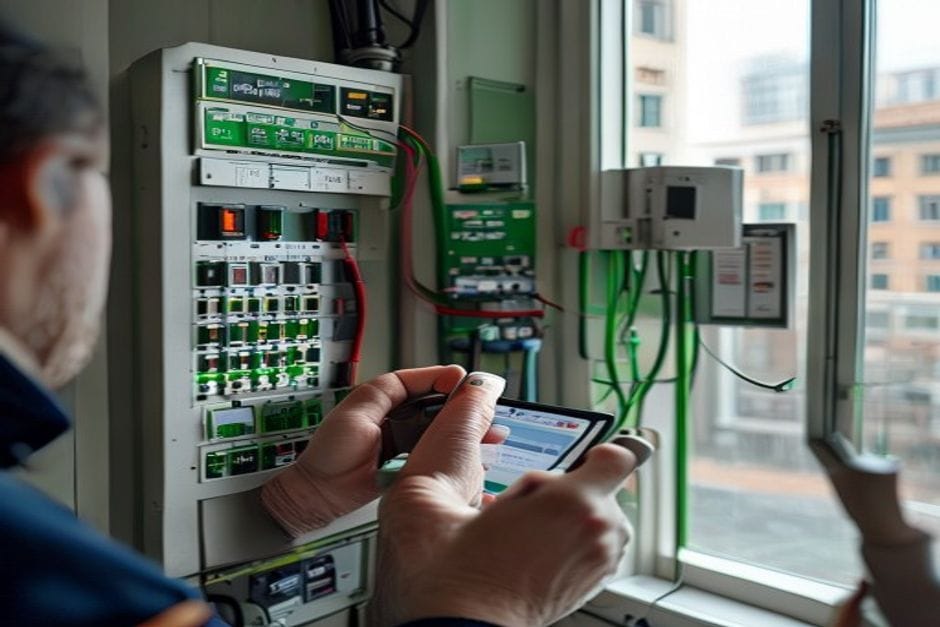
What is the KNX bus and how does it work?
The KNX bus is a dedicated cable that carries all communication between devices in a KNX installation — think of it as the building’s internal phone network. It uses a two-wire cable (typically red and black) that simultaneously delivers the low-voltage power for communication (29 V DC) and the data signals themselves.
In a conventional electrical installation, each circuit needs its own direct wiring. With KNX, all devices share a single network. A KNX actuator — the device that physically executes a command, such as switching a light — receives its instructions through the bus, not through a dedicated cable from the switch. This changes the way you plan and install a project from the ground up.
A good analogy is a building intercom system: every flat is connected to the same network and can communicate with any other by pressing a button. In KNX, instead of voice, the system transmits digital commands. And crucially, none of this requires an internet connection, a router, or a central server. Everything runs locally. If the router goes down, your lights, blinds and heating carry on working without interruption.
This local, peer-to-peer architecture is one of the reasons KNX integration is the preferred choice for serious residential and commercial projects across Europe.
How KNX telegrams work in practice
A KNX telegram is the message that devices send to one another — similar to an SMS, but far faster. When you press a KNX switch, it sends a telegram containing the instruction “light ON” to the actuator responsible for that circuit.
Every KNX telegram contains four elements:
- Source address: which device is sending the command (e.g. the bedroom switch)
- Destination address: which device should act on it (e.g. the ceiling light actuator)
- The command itself: what to do — ON/OFF, set temperature to 22 °C, dim to 50 %
- Acknowledgement: a return message confirming the action was carried out
The entire process takes under 100 milliseconds — faster than a blink. In a 70 m² apartment with 15 KNX switches, the bus can handle 20–30 telegrams per second without any perceptible delay.
By contrast, a Wi-Fi-based smart home system can introduce delays of 1–3 seconds under load, because it depends on the wireless network and, often, an external cloud service. If you want a detailed breakdown, our KNX vs Tuya vs Loxone comparison covers the stability differences in depth.
The practical benefits of KNX communication
KNX’s communication model solves real problems that other smart home technologies struggle with:
- Internet-independent reliability: the system keeps working even when the broadband is down
- Instant response: telegrams arrive in under 100 ms, versus 1–3 seconds on Wi-Fi or Zigbee
- No congestion: the KNX bus supports hundreds of devices without slowing down
- Built-in diagnostics: the system reports exactly which device has an issue and where it is on the bus
- Vendor independence: KNX (ISO 14543) is an open international standard — you are never locked into a single manufacturer
A practical example: in a 200 m² villa with 40 KNX circuits, the owner can simultaneously control lighting, blinds and heating across five zones. Every command executes instantly, and if one switch develops a fault, the rest of the system continues to operate normally.
The long-term cost picture is also favourable. A KNX installation does not need replacing every 3–5 years the way consumer Wi-Fi products often do. After 15 years of operation, you can add new devices without touching the existing cable infrastructure. For a broader look at what this means for your project, see our KNX energy management page.
Technical details for electricians and installers
The KNX bus uses the CSMA/CA protocol (Carrier Sense Multiple Access with Collision Avoidance) to prevent telegram collisions. Before transmitting, each device listens to the bus to check it is free — similar to how people in a meeting wait for a pause before speaking.
Key bus specifications:
- Voltage: 29 V DC (SELV — Safety Extra-Low Voltage)
- Maximum current per segment: 500 mA
- Transmission speed: 9,600 baud
- Maximum segment length: 1,000 m
- Devices per segment: 64 (extendable with repeaters)
The bus can be wired in a star, line or mixed topology — whichever suits the building layout. One practical detail worth noting: the bus has no polarity, so it does not matter which way round you connect the two wires at the terminals.
Bus power supplies (typically 640 mA units) are installed in the distribution board. On larger projects, line couplers are used to separate segments and keep telegram traffic efficient within each zone.
For installers, one of the biggest time-savers is fault-finding: ETS6 programming software shows you exactly where the bus is interrupted or which device is not responding, cutting diagnostic time dramatically.
What happens if the KNX bus is damaged?
The standard KNX cable — shielded YCYM 2×2×0.8 mm — is built to last 20+ years in normal conditions. If a break does occur, only the devices beyond that point lose communication; everything else on the bus continues to function. This makes fault isolation straightforward: the problem is localised, not system-wide.
This is a significant advantage over wireless systems, where a signal issue can affect the entire property at once.
Can I add new devices without rewiring?
Yes. New devices can be connected anywhere on the bus using standard junction terminals — there is no need to run fresh cables back to the distribution board. If you want to add a motion sensor in a hallway, for instance, you connect it to the nearest bus junction box and configure it in ETS6 to control the local lighting. The existing infrastructure stays exactly as it is.
How many telegrams does a typical home generate?
A four-bedroom apartment produces roughly 50–100 telegrams per day under normal use: switching lights, adjusting thermostats, activating morning and evening scenes. The KNX bus is capable of handling thousands of telegrams per second, so capacity is never a concern in a domestic setting.
For scale: a 50-room hotel running full KNX hospitality automation might see 500–1,000 telegrams per hour at peak times — still well under 10 % of the bus’s capacity.
Ready to plan your KNX project?
Whether you are designing a new build, retrofitting a renovation or specifying a commercial installation, understanding how the KNX bus and telegrams work is the first step to getting the architecture right. Our team of certified KNX engineers can help you size the system correctly, plan the topology and deliver a reliable installation. Request a free consultation and we will walk through the specifics of your project with you.





