


Blog
KNX Automation for Medical Clinics: Smart Control Without Major Rewiring

The Challenge: Energy Waste and Manual Control in a Working Clinic
This article is based on a real KNX project we completed for a private internal medicine clinic with eight consulting rooms. The clinic owner came to us with a straightforward problem: energy bills had risen by 35% over one year, and the burden of manually managing lighting and air conditioning across every room was creating daily friction for staff.
The building dated from the mid-1990s and used a conventional electrical installation — manual switches in each room, individual air-conditioning thermostats, and lighting kept at full brightness throughout the day for hygiene reasons.
The specific problems we identified:
- Excessive energy consumption: lights left on for 12+ hours a day, including in unoccupied rooms
- Poor manual discipline: staff regularly forgot to switch off lights or adjust temperature when leaving a room
- No scene flexibility: the same full-brightness lighting was used for consultations, cleaning, and everything in between
- Management overhead: eight consulting rooms, a waiting area, and an administrative zone — all handled individually
The core technical challenge: how do you integrate KNX automation into an active medical environment without disrupting clinical operations or opening up walls in a building that’s nearly 30 years old?
The KNX Solution: Architecture and Installation
We designed a KNX automation system tailored to the specific rhythms of a medical practice. The key decision was to use KNX actuators fitted directly into existing switch positions — no wall chasing, no significant rewiring. Cable runs (approximately 280 metres of dedicated KNX bus cable) were routed through the existing suspended ceiling voids.
System components installed:
- KNX presence detectors: one per consulting room (eight units) plus the waiting area
- Lighting actuators: MDT AKK-0416.03 modules controlling up to four circuits per room
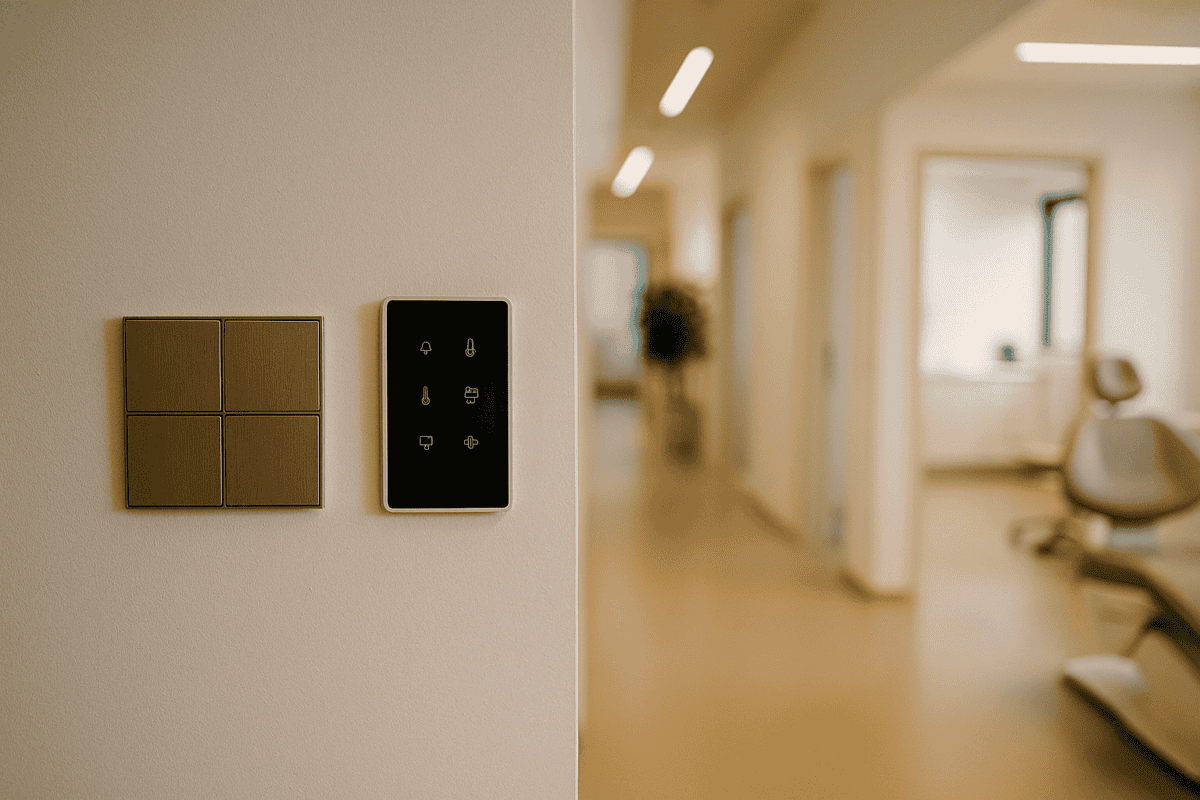
- Touch panels: one per room for quick manual adjustment by clinical staff
- IP gateway: enabling remote monitoring and control
- KNX bus cable: 280 metres routed through existing ceiling voids
For a deeper look at how we approach KNX system design and ETS programming for commercial and specialist environments, see our dedicated service page.
Before and After: What Actually Changed
Before KNX: The clinic owner arrived each morning and switched on every light manually. Lights stayed on all day — including in rooms that sat empty for hours. The cleaning team often left three or four rooms lit overnight. Monthly electricity cost: approximately €250.
After KNX: Lights activate automatically when someone enters a room and switch off when it’s vacated. Brightness adjusts by time of day — 100% during consultation hours (08:00–18:00), 60% during the cleaning window (18:00–22:00), off overnight. HVAC setpoints in unoccupied rooms drop by 3°C automatically. Monthly electricity cost: approximately €150.
The essential difference: the system manages the roughly 90% of the day when rooms are unoccupied, while maintaining full clinical conditions whenever they’re needed.
Results After the First Year
Twelve months after commissioning, we reviewed the figures with the clinic owner:
- Electricity reduction: 40% lower monthly consumption
- Annual energy saving: approximately €1,200 per year on electricity alone
- Staff time saved: around 25 minutes per day — no more manual checks of each room
- Improved patient comfort: lighting automatically suited to each activity
- Zero clinical disruptions: not a single consultation affected by a technical issue
The system generates monthly reports showing consumption per room. One useful discovery: two rooms were using around 60% more energy than the others — a problem quickly identified and resolved through the reporting data.
Compared with a similar clinic nearby without automation, energy consumption per square metre was 38% lower. This is consistent with what we see across KNX projects in commercial and specialist buildings more broadly.
Key Lessons for Anyone Planning KNX in a Medical Setting
If you’re considering KNX automation for a clinic or medical practice, here’s what this project taught us:
- Presence detection is the highest-impact investment: around 80% of the energy saving came from automatic switch-off in empty rooms. Payback on presence detectors alone is typically 8–10 months.
- Always preserve manual override: clinical staff must be able to override the system instantly. Touch panels at each room are non-negotiable.
- Design scenes around activities, not just schedules: consultation lighting, cleaning lighting, and emergency overnight lighting are three distinct needs. Build them in from the start.
- Phase the rollout if needed: start with lighting (immediate impact), then extend to HVAC and other systems as staff grow comfortable with the technology.
Total investment for this 150 m² clinic: approximately €4,800 (equipment plus installation and programming). At roughly €1,200 annual savings, the payback period is around four years — a reasonable return for a commercial healthcare space. Our KNX energy management service includes consumption reporting and ongoing optimisation to keep those savings on track.
What Happens if KNX Equipment Fails During a Consultation?
MDT KNX actuators retain full manual functionality even if the bus is interrupted. The physical switch on the wall continues to work normally — patients notice nothing. We also installed bypass circuits for every critical circuit as standard practice.
Does KNX Meet Medical Hygiene and Safety Standards?
The KNX protocol (ISO 14543) is certified for use in medical environments. The 24V bus does not interfere with medical equipment, and all components carry CE certification. Presence detectors specified for clinical spaces are designed to avoid harbouring dust or bacteria.
Can Clinical Staff Manage the System Themselves?
Day-to-day operation via the touch panels is straightforward and requires no technical knowledge. For scene changes or parameter adjustments, we offer a KNX remote support and maintenance contract covering remote intervention and quarterly system reviews. The clinic owner in this project handles all routine operations herself.
Thinking About KNX for Your Medical Facility?
Whether you’re running a single-specialist practice or a multi-room clinic, KNX automation can deliver real, measurable results — lower energy bills, less staff overhead, and a better environment for patients — without tearing the building apart. If you’d like to discuss your specific situation, request a free consultation and we’ll help you work out what’s achievable in your space.





